
How to Reduce LLM API Costs Without Sacrificing Product Response Quality:
Cost Governance Strategy for Production AI
For production AI systems, reducing LLM API costs is not only about watching a bill after the fact. DoCoreAI focuses on the runtime: predicting token usage, pacing budgets, applying token-level governance, and enforcing defined cost policies while your application continues to call the LLM directly.
Privacy-first · No gateway · No prompt storage · OpenAI · Anthropic · Gemini · Groq · AWS Bedrock · Ollama
What Actually Needs to Be Controlled?
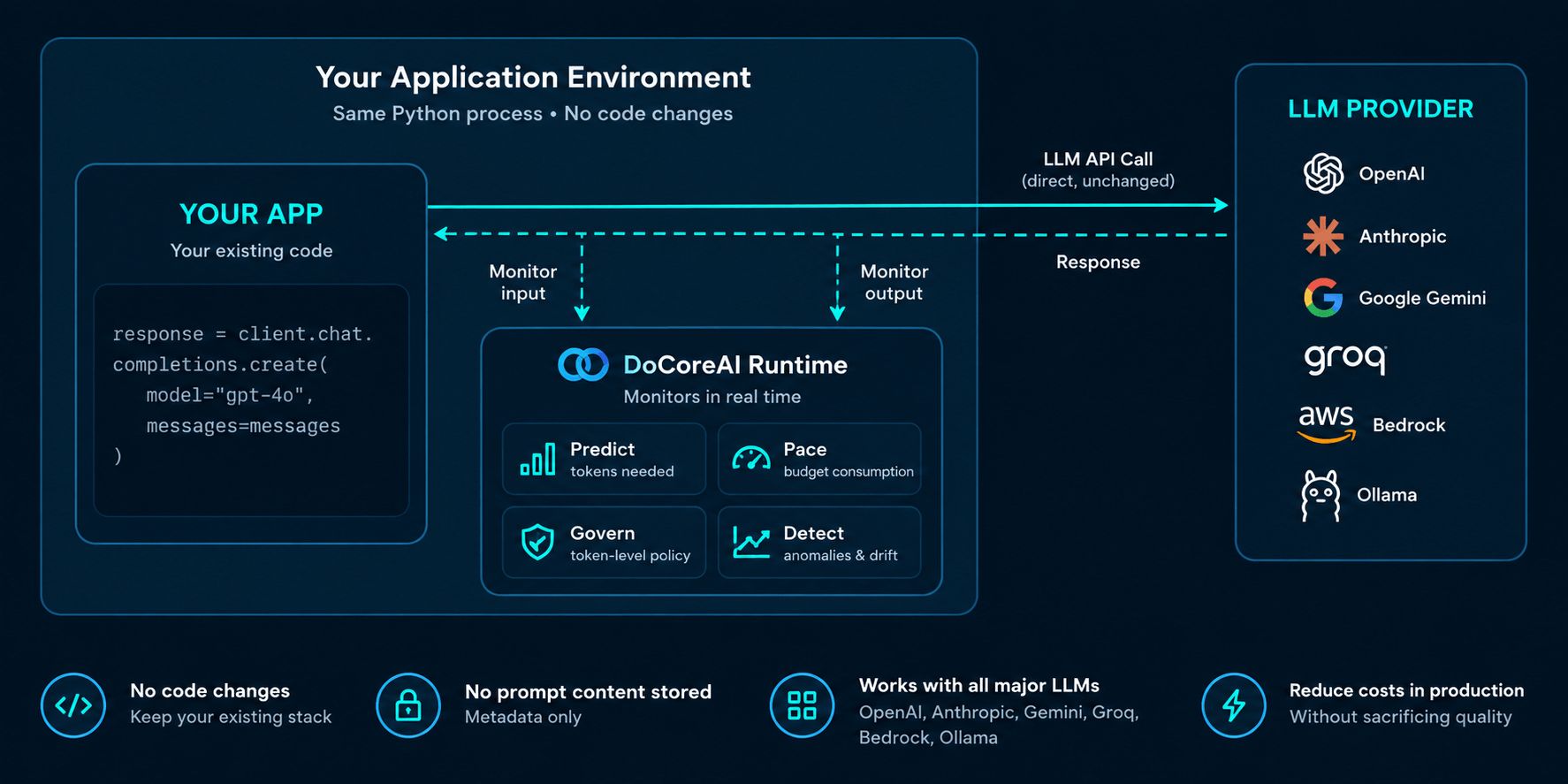
DoCoreAI approaches LLM cost reduction from a specific place in the stack: the runtime of the AI application. It instruments LLM SDK calls locally, extracts cost and token metadata, predicts the tokens needed for a request, and applies governance, budget, and pacing decisions. Your application continues to call the LLM provider directly.
That means this guide is deliberately narrow. It focuses on the cost-control mechanisms DoCoreAI presents as part of its platform: token prediction, budget allocation, budget pacing, token-level governance, autonomous enforcement, anomaly detection, and continuous model improvement through drift detection and auto-retraining.
Why Production LLM Spend Becomes Difficult to Control
DoCoreAI's homepage describes a common production scenario: an AI feature ships, usage grows, and the engineering team needs a way to understand and govern spend without creating a new request-path dependency.
1Silent Token Waste
DoCoreAI highlights workloads where a large output ceiling is used as a safety net even though typical responses use much less. Its token prediction engine is designed to learn request patterns and predict the tokens needed for each request.
2No Native Budget Guardrails
Engineering teams can see spend, yet still lack a runtime mechanism for pacing or enforcing an AI budget. DoCoreAI adds budget pacing and autonomous governance at the application layer.
3Spend Across Teams and Environments
One company-wide number does not show where the spending is happening. DoCoreAI supports budget allocation across teams, clients, applications, and environments, with per-environment budgets.
4Unexpected Runtime Behaviour
When usage patterns change, a static control can become less useful. DoCoreAI describes drift detection and automatic retraining so its prediction model can adapt as behaviour changes.
How DoCoreAI Reduces LLM API Costs
After the common cost-reduction techniques are in place, production teams still need a way to govern AI spend continuously. DoCoreAI adds a runtime layer: observe the call locally → predict token usage → pace the budget → apply governance → record cost metadata.
1. Predict the Tokens Needed for Each Request
DoCoreAI describes a local training process that learns call patterns from runtime metadata and uses a LightGBM model to predict the exact tokens needed per request. The purpose is to replace a broad, static allowance with a prediction based on observed workload behaviour.
This is important for engineering leadership because the problem is not simply “how many tokens could this request use?” The operational question is “how many tokens does this workload typically need?”
2. Pace AI Spend Against the Budget
A token prediction by itself does not create cost control. DoCoreAI combines prediction with a Budget Pacing Engine. The homepage describes this as automatically pacing AI spend to prevent budget overruns before they happen.
This changes the engineering problem from: “What did we spend?” to: “How should the remaining budget influence runtime decisions?”
| Without runtime pacing | With DoCoreAI's governance approach |
|---|---|
| Review spend after usage occurs | Use current budget consumption as part of runtime governance |
| Budget is mainly a reporting number | Budget becomes an input to runtime control |
| Intervention may be manual | Governance decisions can be applied automatically |
3. Apply Token-Level Governance
DoCoreAI explicitly describes token-level governance as a platform capability. The control is therefore applied at the level that directly influences token consumption rather than being limited to a dashboard that reports the bill later.
The homepage also describes autonomous enforcement and multiple budget-control behaviours in its product documentation. The exact enforcement policy should be chosen according to the application's requirements and budget policy.
4. Allocate Budgets Across Teams, Clients, Applications, and Environments
Engineering organizations often do not operate one AI workload. They may have several products, environments, teams, or customer-facing workloads using LLM providers at the same time.
DoCoreAI's homepage describes budget allocation across teams, clients, applications, and environments, together with per-environment budgets. That allows the organization to make the budget a policy at the workload level rather than only at the company level.
5. Catch Anomalies in AI Spend and Usage
DoCoreAI describes anomaly detection as part of its runtime governance stack. The purpose is to catch unusual behavior rather than relying only on end-of-month reporting.
For a CTO or VP Engineering, the useful question is not just whether an anomaly exists. It is whether the organization can connect that anomaly to the workload, model, token behaviour, and governance decision quickly enough to act.
6. Continuously Improve Prediction Through Drift Detection
A production workload can change after deployment. Request patterns can shift, response behaviour can change, and assumptions that were useful during training can become less accurate.
DoCoreAI's homepage describes a Drift Detector that monitors prediction accuracy continuously. When prediction drift crosses its stated threshold, the platform can trigger Auto-Retrain and promote a new model when the stated improvement criterion is met.
7. Do It Without a Gateway or Application Rewrite
Cost control is only useful if it can be introduced without creating a new operational dependency in the request path. DoCoreAI's homepage describes a no-gateway architecture: the application calls the LLM provider directly, while DoCoreAI runs alongside the application through local SDK patching.
The same homepage also describes zero code changes and a three-command installation flow. This is the architectural distinction behind the governance model described in this article.
| DoCoreAI design choice | What it means for engineering |
|---|---|
| No gateway | The application continues to make the LLM call directly. |
| Same-process SDK patching | Governance operates alongside the application rather than through a network proxy. |
| No code changes | The homepage describes installation without rewriting existing application code. |
| Fail-open design | The homepage says the application and LLM calls continue if instrumentation cannot be applied. |
Privacy-First Cost Governance
DoCoreAI's cost-control architecture is intentionally metadata-only. Its homepage states that prompts and responses are not recorded and that DoCoreAI extracts cost and token metadata locally. The cloud receives metadata rather than prompt content.
The homepage lists runtime metadata such as timestamp, model name, token count, estimated cost, latency, and the governance decision applied. This is the data layer DoCoreAI uses to support cost governance without storing the contents of the AI interaction.
A Practical CTO / VP Engineering Cost-Control Framework
| Leadership question | DoCoreAI capability relevant to the question |
|---|---|
| How much AI spend does each workload consume? | Cost and token metadata with workload-level budget allocation. |
| Can we predict token demand? | Token Prediction Engine using learned runtime patterns. |
| Can we keep spend inside a defined budget? | Budget Pacing Engine and autonomous enforcement. |
| Can we govern different environments? | Per-environment budgets. |
| What happens when usage behaves unexpectedly? | Anomaly detection and governance decisions. |
| What happens as workload behaviour changes? | Drift detection and auto-retraining. |
| Can we add governance without a proxy? | No-gateway, same-process SDK patching. |
| Can we keep prompts out of the governance platform? | Zero prompt storage and metadata-only telemetry. |
What This Means for a Production AI Team
For engineering leadership, the practical shift is from reporting AI spend to governing AI spend at runtime.
DoCoreAI's approach is built around four linked actions:
1Predict
Use learned runtime patterns to predict the tokens needed for a request.
2Pace
Use budget consumption as part of the runtime governance decision.
3Enforce
Apply token-level and budget policies automatically according to the configured governance mode.
4Adapt
Monitor prediction drift and retrain when production behaviour changes enough to affect prediction accuracy.
DoCoreAI's Runtime Cost Governance in One Diagram
CTO / VP Engineering Checklist
How DoCoreAI Fits Into Your Existing AI Stack
DoCoreAI describes itself as operating at the AI application layer. It is intended to complement existing FinOps and observability systems rather than require a replacement for them. Its role is to govern AI spend close to the application that is making the LLM calls.
That distinction is important for engineering leadership: your existing systems can continue providing broader infrastructure, observability, or financial reporting, while DoCoreAI focuses on runtime AI cost governance.
Frequently Asked Questions About Reducing LLM Costs
How do you reduce LLM costs?
What is the biggest driver of LLM cost?
Does using a smaller LLM reduce costs?
Does caching reduce LLM API costs?
How can I control LLM spending in production?
What exactly does DoCoreAI do to control LLM costs?
Does DoCoreAI sit between my application and the LLM provider?
Does DoCoreAI reduce input tokens?
What exactly does DoCoreAI do to control LLM costs?
Does DoCoreAI sit between my application and the LLM provider?
Does DoCoreAI store prompts or model responses?
Which LLM providers can DoCoreAI govern?
Can DoCoreAI help with budget overruns?
What happens when workload behaviour changes?
Model and API settings can affect application behaviour, but they are only one part of production AI cost control. For example, see our guides on Claude API settings and OpenAI temperature settings. For runtime cost governance, see how to reduce LLM API costs.
Go Deeper
Explore how DoCoreAI's approach connects to AI cost governance features, privacy and security architecture, and the developer documentation.
The technical capabilities and provider coverage described above are based on DoCoreAI's current public website. Recheck the product documentation before publishing time-sensitive implementation details.