
The Ultimate Guide to Privacy-Preserving LLM Observability: Governing AI Costs at the Edge
Large language models have introduced a new operational challenge for engineering teams: unpredictable token consumption. This definitive guide explores how to extract operational metrics locally, inside the application runtime, without storing prompt content or transmitting sensitive data to third parties.
Why Cloud Proxies Fail the Enterprise Compliance Test
Many modern AI observability platforms rely on a cloud gateway proxy architecture. While this approach simplifies deployment, it introduces catastrophic data visibility challenges for organizations operating under HIPAA, GDPR, SOC 2, or tight internal financial regulations.
The core vulnerability is data transit. When request loops route through a third-party gateway, sensitive business layers leave your environment:
- Proprietary system prompts and multi-turn user conversations.
- Retrieval-augmented generation (RAG) context histories pulled from internal vector engines.
- Protected health information (PHI) and raw customer identifiers.
The Privacy-First Local Extraction Alternative
A privacy-first LLM cost observability architecture eliminates the need to inspect prompt contents entirely. Instead of parsing text, operational tracking metrics are calculated directly via local telemetry hooks inside your application framework.
Telemetry structures extract purely numeric metadata parameters at the runtime execution point:
llm_usage_tokens_input– Measures raw context length to identify prompt bloat or massive RAG histories.llm_usage_tokens_output– Tracks generation sizes to detect loop patterns or verbosity spikes.gen_ai_request_model– Identifies cost variations and protects against unauthorized preview/premium model usage leaks.
Moving to Autonomous AI Cost Governance
Traditional dashboards provide retrospective metrics, showing what you spent yesterday after the invoice clears. True cost stabilization shifts the pattern to active, real-time control thresholds.
Hard Truncation vs. Soft Pacing
Engineers generally avoid hard token execution ceilings because they drop application threads mid-generation and break production workflows. Instead, an intelligent AI budget pacing algorithm balances your available daily token allocation against remaining operational hours:
Target Consumption Rate = Available Daily Budget / Hours Remaining
When consumption tracks ahead of pace, the local engine introduces graduated soft controls—reducing maximum output generations or altering routing rules safely without runtime errors.
Predictive Modeling via Local Machine Learning
Static thresholds miss traffic spikes. By running a lightweight LightGBM forecasting framework locally within your runtime node, the tool maps invocation histories and flags potential budget breaches hours before they manifest. If token behavior moves away from normal run-rates, internal telemetry tables trigger automated retraining pipelines to maintain precise pacing integrity.
Implementing Telemetry via Runtime Monkey-Patching
Developers avoid adding large monitoring codebases. Runtime monkey-patching injects tracking modules directly into native wrappers (OpenAI, Anthropic, Gemini, Groq, Bedrock) during initialization without mutating business logic code.
| Traditional Tracing Approach (Complex) | Modern Runtime Telemetry (Clean) |
|---|---|
|
|
Control variables are injected seamlessly via standardized system environment flags:
DOCOREAI_ENABLE=true
DOCOREAI_LOG_ONLY=true
DOCOREAI_API_URL=http://localhost:8000
DOCOREAI_TOKEN=local_runtime_token
💡 For a step-by-step technical guide to managing environment variables locally, check out: How to Track LLM API Costs and Token Spend Without Storing Prompts.
Note: DoCoreAI version 2+ does not allow direct usage of .env file. The configurations are done at the client-side UI.
What to Expect in the First 10 Minutes
Implementing enterprise budget safeguards shouldn't equal massive system friction. Here is the realistic onboarding loop from zero to local metadata visibility:
Install the localized package dependency and initialize the automated runtime engine hooks within your application stack.
Pipe automated sample traffic through your system loops to ensure numeric token parameters and model types parse safely.
Audit local storage tables to confirm cost estimates match model weights with complete zero prompt logging.
Set active pacing rules and soft warning levels to protect system resources against script anomalies or cost spikes.
Product Walkthrough & Architecture Validation
To ensure total operational clarity, engineering teams should evaluate interactive dashboard tracking views and structural data mapping flows directly within their environments.
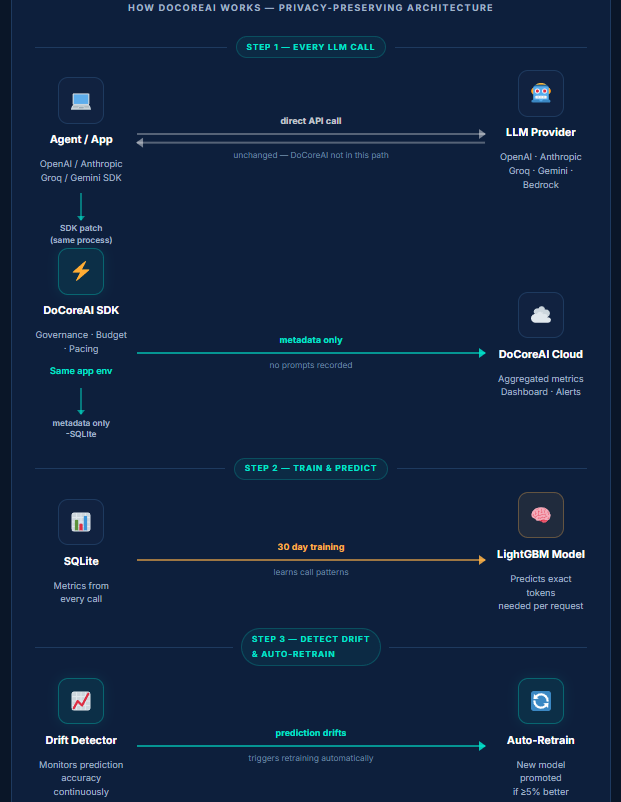
DoCoreAI never sits in your call path. It monkey-patches the LLM SDK locally — listening before and after each call in the same Python process. Your app calls the LLM directly, unchanged. Only cost and token metadata is sent to the cloud. Prompts never leave your network.
Start Measuring Metadata, Not Prompts
Protect your cloud application infrastructure budget while reinforcing strict data governance boundaries. Deploy localized runtime telemetry in under 10 minutes.